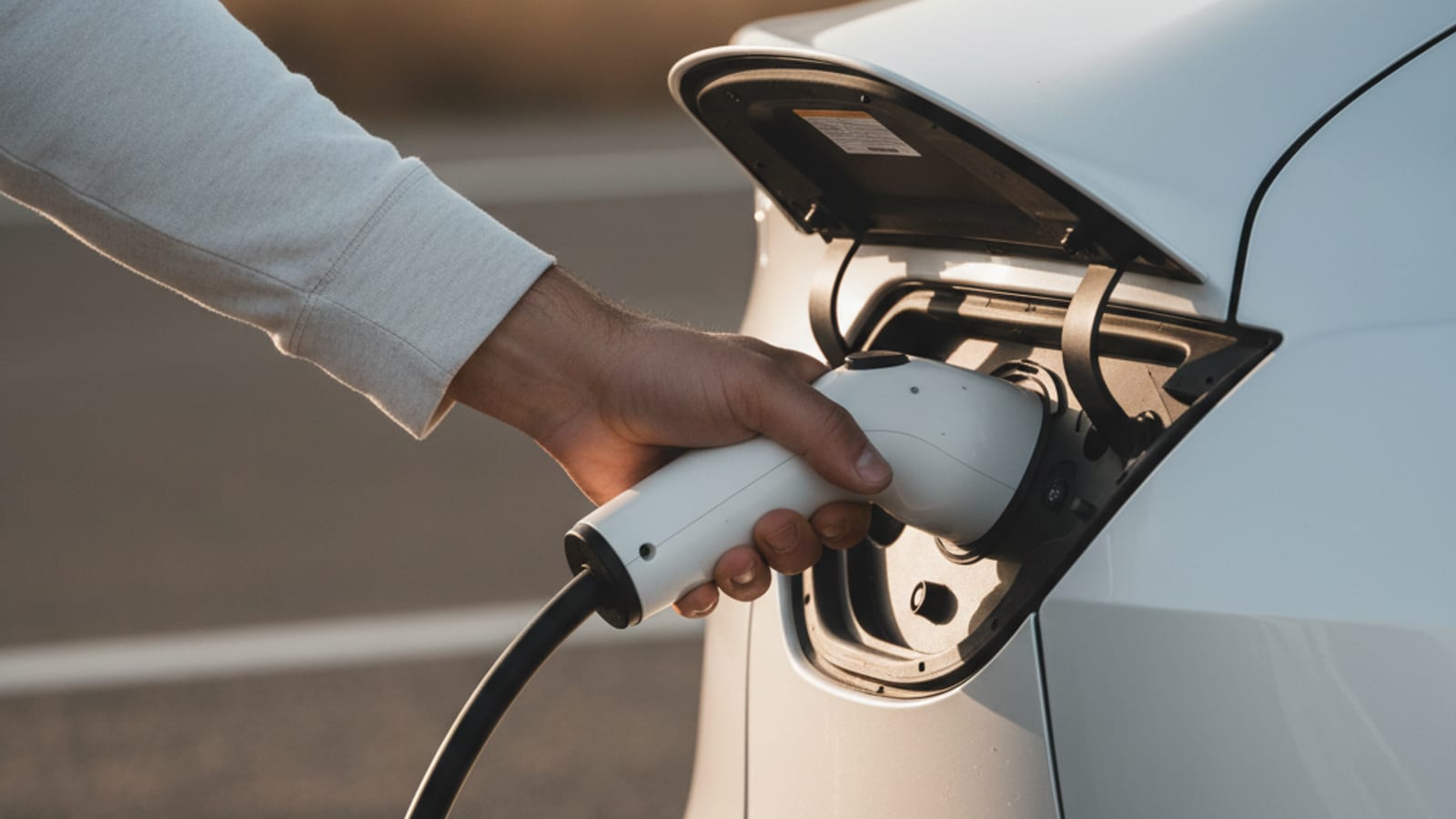
You finish charging, walk up to the car, press the release button on the connector — and nothing. The cable won’t come out. Or worse, you’re standing at a Supercharger with a line behind you and the car refuses to let go. This happens more than anyone admits. Almost always, it’s fixable in under two minutes once you know where to pull.
Here’s why charge ports lock, why they sometimes won’t release, and the exact manual release location for the EVs we see in San Diego County.
Why charge ports lock in the first place
EVs lock the cable during charging for two reasons:
- Safety. A cable accidentally yanked mid-charge would expose a live DC or high-power AC connector. The lock keeps the circuit connected until current stops flowing.
- Theft prevention. Especially at home. If the cable could be unplugged by anyone walking past, someone could unplug your charge and plug in their car on your rate.
The lock is a small electric solenoid inside the charge port. When the car says “release,” the solenoid retracts and the latch that grabs the connector swings clear. If the solenoid doesn’t hear the release command, or doesn’t have power to act on it, the cable stays put.
The common causes of a stuck cable
In order of how often we see it:
1. Paused or glitched charge session
If the charger stops delivering power but the session didn’t officially end in the car’s software, the lock stays engaged. Fix: from the car’s screen, tap “Stop Charging” and wait for the “Charging Stopped” confirmation before pulling.
2. Low 12V battery
The solenoid needs 12V power to release. If the 12V is weak or dying, the release command goes through but the solenoid can’t actuate. Fix: jump the 12V (see our jump-start guide) and try again.
3. Software glitch
Sometimes the car’s software simply forgets the charge happened. A reboot resolves it. For Tesla, hold both scroll wheels for 10 seconds. For Rivian, press and hold the cruise control stalk down for 10 seconds. For most others, turn the car off and on at the power button.
4. Handle latch failure on the cable
Older Tesla Mobile Connectors and some Supercharger cables have physical latch button issues — the button no longer fully depresses the internal mechanism. This is a cable problem, not a car problem. Try a different cable if you can.
5. Stuck solenoid (physical failure)
Rare. Solenoid is seized or has corrosion. Requires service or a manual release workaround.
The manual release: every EV has one
Manufacturers know ports fail. There’s always a mechanical way to free the cable without destroying anything. Here’s where.
Tesla Model 3 and Model Y
Open the trunk. On the passenger side, peel back the carpeted trim along the inner wall. You’ll find a small access panel — remove it. Behind the panel is a plastic tab connected to a cable. Pull the cable downward, firmly, and hold it. The latch releases. Remove the charge cable while still holding tension.

Tesla Model S and Model X
Open the rear hatch. On the driver’s side, behind the taillight area, there’s a carpeted access panel. Pull the plastic trim away. Inside is a release cable — pull straight toward you. On 2021+ refresh S and X, the cable is instead in the trunk trim on the passenger side (similar to Model 3).
Rivian R1T and R1S
Manual release is inside the car. Open the rear passenger-side door. Under the rear seat, lift the seat bottom to access a service panel. Inside is a manual release cord. Pull firmly.
Ford F-150 Lightning and Mustang Mach-E
Ford put the manual release in the charge port itself. Open the charge port door. Near the top or bottom edge of the port housing, there’s a small triangular pull tab marked with an “unlock” icon. Pull it away from the port while simultaneously pulling the cable. On Lightning, the release can also be operated from the FordPass app even if the car is unresponsive.
Hyundai Ioniq 5, Kia EV6 and EV9
Both Hyundai and Kia put a manual release button inside the rear cargo area, under a plastic cover on the driver’s side sidewall. Pull the cover off. Press and hold the small button while pulling the charge cable.
Chevrolet Bolt
Manual release cord is under the rear cargo floor, alongside the 12V battery area. Pull the cord while pulling the cable.
Polestar 2
Similar to Rivian. Manual release cord accessible from inside the trunk, near the driver’s side tailgate hinge, behind a small trim panel.
Volkswagen ID.4
Manual release is a cable inside the trunk, on the passenger side behind the C-pillar trim. Lift the cargo cover and look for a labeled pull loop.
What to do if the manual release doesn’t work
You pulled the cable. Nothing moved. Now what.
First, confirm the car is awake. A sleeping EV sometimes looks unresponsive but comes back if you open and close the driver’s door. Then try the manual release again.
Second, try rocking the connector as you pull. Not hard — just wiggling side to side while pulling the manual release. Sometimes the latch is mechanically stuck on the connector’s locking lip and a small wiggle frees it.
Third, try a short reboot. Hold the brake and both steering wheel scroll wheels (Tesla) or hold the start button for 10 seconds (most others) to soft-reset the car. After reboot, the software may release the lock on its own.
If the manual release doesn’t work and wiggling doesn’t work, stop pulling. A stuck solenoid that you tear out through brute force becomes a $600 charge port replacement instead of a 10-minute service call. Walk away, call us, and leave the cable in place until we arrive.
When to call us
Call (858) 400-8901 if:
- Manual release pulled cleanly but the cable still won’t come out.
- The car is completely dead and you can’t reach the manual release.
- You’re at a busy Supercharger and blocking a stall.
- The cable handle’s own release button is physically broken.
We carry 12V jump packs (most stuck-cable calls resolve once the 12V is restored), basic port lubricant for sticky latches, and the tools to access every major EV’s manual release without damaging trim. Most stuck-cable calls are a 20-minute visit.
Browse our Tesla roadside rescue and non-Tesla EV rescue pages for full service coverage.
After you free the cable
Once the cable is out, take the car to a charger and run a full session. If it completes and releases normally, you were probably dealing with a glitched session. If the lock fails again, it’s time for a service appointment to inspect the solenoid.
If you had to jump the 12V to free the cable, replace the 12V soon. It’s on its way out.
Cable stuck in San Diego County? Call (858) 400-8901. We’ll talk you through the manual release on the phone, and if that doesn’t work we’ll roll a truck. Dispatch is 24/7.