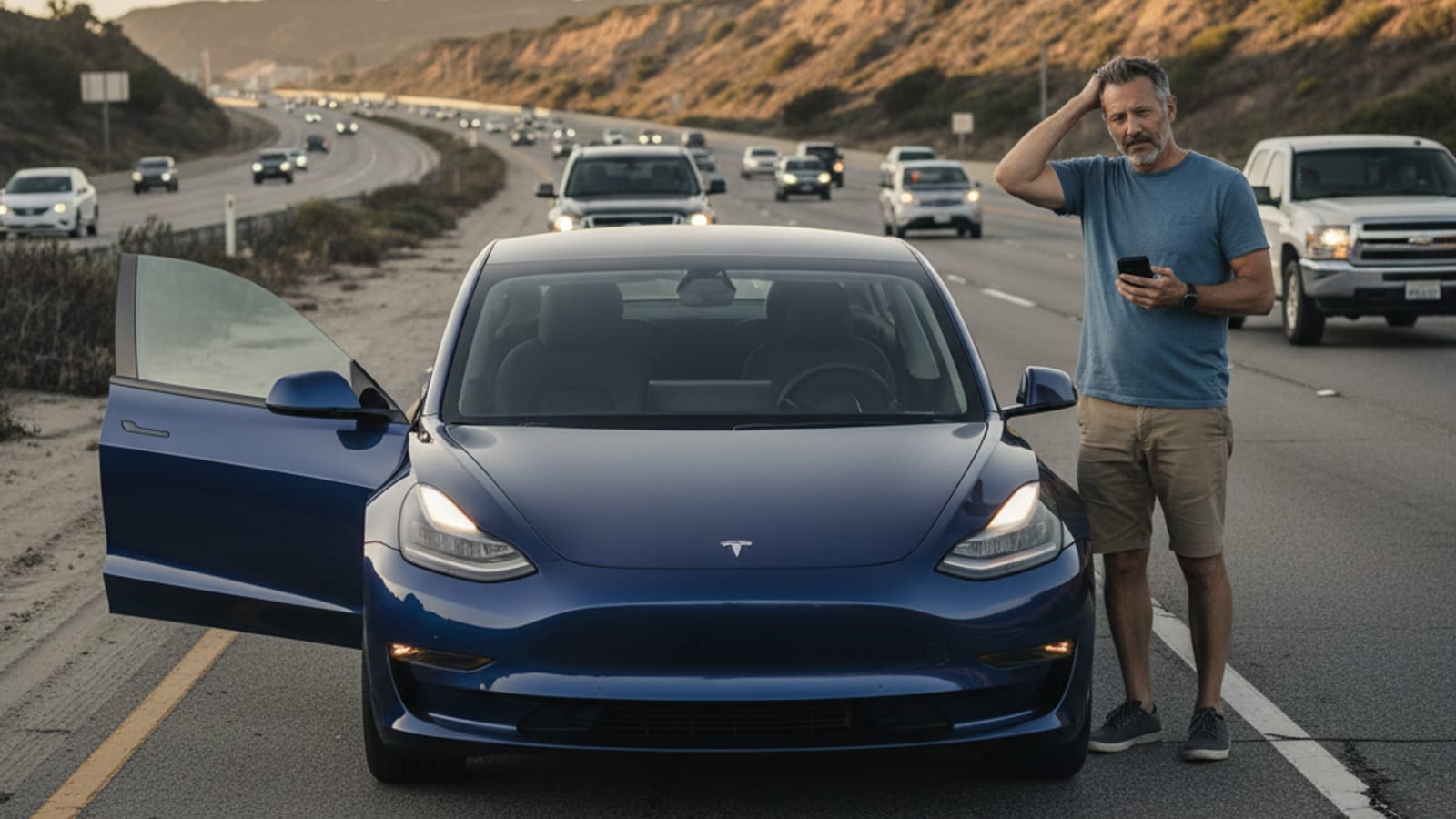
The range estimate dropped faster than you planned. The display flips to zero. Power drops. You’re watching the shoulder slide past on I-5 and thinking through a short list of bad options. This guide is for that moment. Read it now, save it for later, and know what to do when it happens.

Every EV handles the last few percent differently, but the physics are the same. Here’s what actually happens, and how to get moving again with the least drama.

What happens when the pack reads zero

The range estimate isn’t a fuel gauge. It’s a prediction based on recent driving. When it hits zero, there’s usually a small reserve left — 2 to 8 miles depending on the car, the temperature, and how hard you’ve been pushing.

In a Tesla, you’ll see warnings starting around 20 miles. Below 10, the car pleads with you to find a Supercharger. At zero, the car enters a limp mode that caps speed and cuts climate. Below that, the traction motor stops driving the wheels. You coast.

Other EVs are similar. Rivian, Ford Lightning, Ioniq 5, EV6 — all give you a reserve, all cap speed near empty, all eventually stop.

Pull over now, not in a minute

If you’re on I-5, I-15, or I-805 and you see the warning, don’t try to make the next exit. Pull over while you still have power steering and brake assist.

  1. Flip the hazards the moment you know you’re in trouble.
  2. Pick the right shoulder. Left shoulders on San Diego freeways are narrow and dangerous.
  3. Get as far right as you can — past the white line, onto dirt if there’s dirt.
  4. Turn the wheels away from traffic once you stop.
  5. Stay in the car unless you can get over a barrier or onto a wide dirt shoulder. Standing beside a running lane at highway speed is the single biggest risk in this whole situation.

If you’re in a construction zone, a tunnel, or on a bridge — call 911. CHP will roll a unit to push traffic around you. That’s their job and they’re good at it.

Can you coast or roll to the next exit?

Maybe. If you see the exit sign and you’re in the right lane, sometimes you can glide down a gradient with momentum. An EV in neutral coasts fine. The risks:

  • You lose power steering quickly at low speed in most EVs. Steering gets heavy.
  • Power brakes stay functional for several pumps, then get very firm.
  • If the pack fully shuts down, the parking pawl may engage when you stop. You’ll need a flatbed, not a roll.

The safer call is to pull over early, hazards on, and work the problem from a stationary car. Coasting into an unfamiliar exit with dying steering is how minor strandings become body-shop stories.

Why AAA may not be the fast answer

AAA covers EVs. The part nobody mentions is that most AAA contractors still roll gas-vehicle equipment. When your Tesla won’t charge from a standard 120V outlet on the back of a service truck, the dispatcher sends a flatbed. Tow to the nearest Supercharger. Wait for charge. Drive home.

On a weekday in Carlsbad, that process is two to four hours. On a Sunday afternoon on the I-8 near Alpine, it can be six. AAA isn’t doing anything wrong — they’re just not equipped for on-site high-power EV charging. For a dead 12V battery or a flat tire, they’re great. For an empty traction pack, they’re a tow, not a rescue.

A Charge Pro SD technician deploying orange reflective cones behind a stranded Tesla on a San Diego freeway shoulder with a rescue truck parked just behind
A mobile rescue truck with a 50-foot NACS cable gets you back on the road in about an hour. Photo: Charge Pro SD.

The mobile charging option

We roll out with a 240V, 9.6 kW Level 2 outlet and a 50-foot NACS cable. We pull onto the shoulder behind you, set cones, and plug in. In 15 to 30 minutes we add 10 to 20 miles — enough to reach the nearest Supercharger or roll home if you’re close.

Urban San Diego arrival is typically 25 to 60 minutes. If you’re out near Julian, Alpine, or Ramona, budget 75 to 90. Our dispatch line runs 24/7 at (858) 400-8901.

We’re not a DC fast charger. We’re a Level 2 AC top-up — the same rate as a home wall charger. That’s by design. Fast charging on a freeway shoulder isn’t safe. Adding enough range to reach real infrastructure is the right call, and 20 minutes of AC gets you there.

Quick decision tree

Use this to decide in the moment.

SituationBest move
Pack empty, you’re safe on the shoulder, Supercharger within 20 milesMobile charge, roll to Supercharger
Pack empty, you’re in a lane or on a bridgeCall 911, then mobile charge or tow
12V also dead (no screens, no handles)Mobile rescue with 12V jump + charge
Collision, warning lights, smoke, fluid, or damageTow, not charge. No exceptions.
Pack empty, you’re walking distance from home or a chargerWalk, charge a level 1 adapter, tow if needed
Safety first

Never stand outside your vehicle on a live freeway shoulder unless you’re over the barrier or on a wide dirt berm. Stay buckled, hazards on, and wait for help to arrive.

What to tell the dispatcher

When you call (858) 400-8901, we need three things fast:

  1. Exact location. Freeway, direction of travel, nearest exit or mile marker. “I-15 north, just passed Rancho Bernardo exit, about a mile before Pomerado” is perfect.
  2. Vehicle. Year, make, model. Tesla Model 3, Rivian R1S, Ford Lightning — the cable we need changes.
  3. State of the car. Pack dead only, or also 12V dead? Any warning lights? Any collision damage?

That gets the right truck with the right cable in the right direction. Most calls are rolling in under five minutes from your first ring.

After you’re moving again

Once you’re at a Supercharger or back home, take 10 minutes to plan differently. Most out-of-charge calls we run share a pattern: the driver trusted the in-car range estimate on a cold, windy, or uphill leg. The estimate is optimistic in those conditions.

Rules of thumb for San Diego:

  • Add 15% buffer for I-15 north past Escondido (climbs).
  • Add 20% for I-8 east past La Mesa (climbs harder).
  • Add 10% for cold mornings below 50°F.
  • Never leave home below 30% if you’re driving east of I-5.

When to call us

If you’re stranded, call (858) 400-8901. We’ll tell you on the phone whether mobile charging is the right answer for your situation, or whether you need a tow. No upsell. If a tow is faster or cheaper for your case, we’ll say so.

Learn more about our out-of-charge recovery and EV roadside assistance services, or dispatch now from anywhere in San Diego County.


Stranded right now? Call (858) 400-8901. Dispatch is 24/7, 365 days a year. We carry enough power to get you moving, and enough cable to reach you wherever you stopped.