A dark Model S on a San Diego driveway is usually a low-voltage problem, not a dead drive pack. Tesla does not publish a public Tesla Model S 12V battery replacement cost you can treat as a quote. Before you pay anyone in the county, confirm the year, the low-voltage system, the written line items, and the VIN warranty.
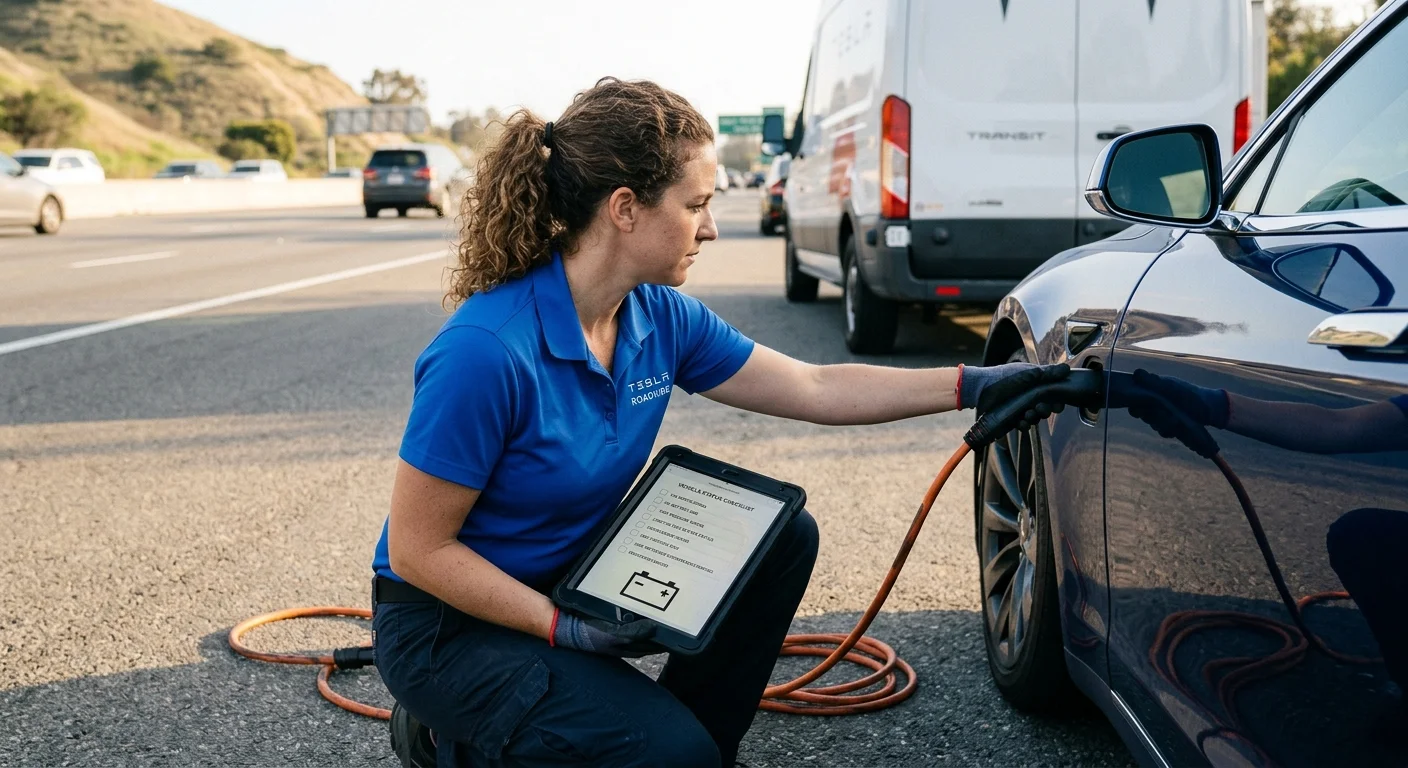
Confirm the Model S and model year
The Model S changed across a long production run. A quote written for “a Tesla” is not a quote for your sedan. Ask the writer to put Tesla Model S, the model year, and the VIN on the estimate before you compare shops.
That check matters in San Diego County because the local fleet is mixed. Early cars park next to later refresh cars in the same Mission Valley garage. Coastal cars and inland cars sit together at SAN. A parts counter cannot see any of that from a phone call. They can see a year and a VIN.
If the car will not wake, do not guess the year from memory. Pull it from the Tesla app, the registration, or the door label. If you cannot open the door, say that first. A locked Model S on a street in North Park is a different job than a car already in a bay. Start with the Model S no-start guide if the screens stay dark and the handles stay flush.
Keep this sedan off other models’ paperwork. Model 3, Model Y, and Model X use different bodies and different service paths. The Model X 12V price checklist is the closest sibling, and it still is not a Model S. Use the lineup-wide 12V cost guide only as background.
If the quote talks about a high-voltage pack, stop. That pack lives under the floor and moves the car. The accessory battery keeps computers, locks, and wake functions alive. Mixed quotes are how owners get a five-figure number for a 12V job, or a cheap auto-parts number for the wrong part. Search results do that mix constantly. Your estimate should not.
Confirm the job type in one line: diagnosis, temporary jump, or replacement. Those are three bills. Charge Pro SD does not set any of them. We connect you with licensed, independent local operators. The operator you hire names the price.
Identify the low-voltage system involved
Search results still say “12V” for every Model S. That is the query people type. It may not be the hardware in your car.
Tesla has used more than one low-voltage design across its lineup. Charge Pro SD could not confirm, from Tesla’s current New Vehicle Limited Warranty PDF or from Tesla’s public Model S materials in our claims ledger, a single published chemistry, group size, or voltage for every Model S year. We also could not confirm a Tesla-published cutoff date when this sedan moved off a conventional 12-volt accessory battery. If a parts site names a year split, treat it as their claim until Tesla or a shop confirms it on your VIN.
So you ask. Have the estimator write the system they are pricing: 12-volt accessory battery, later low-voltage battery, or another assembly they can name from Tesla parts. If they cannot name it, the number is not ready.
Do not accept a gas-station battery by group size alone. A Model S is not a gasoline car with an alternator. Generic “car battery” ranges from consumer sites do not apply here. The U.S. Department of Energy’s electric vehicle overview is a reminder that the architecture is different. It does not list a Model S 12V price, and neither do we.
If someone offers a lithium drop-in, an aftermarket chemistry, or a forever-battery pitch, pause. Charge Pro SD has no verified Tesla document that authorizes a specific aftermarket 12V for Model S, and we will not invent compatibility years. Ask Tesla or the installer, in writing, whether that part is approved for your VIN. Ask what happens to remaining vehicle coverage if an unapproved part is installed. We could not confirm a Tesla public rule on that point from the warranty PDF we have. The VIN screen in the Tesla app still controls.
San Diego heat and long sits change the failure you feel, not the part you should guess. A Model S that sleeps for a week at SAN, or in a closed downtown garage, can show a low-voltage no-start even when the drive pack still has range. East County heat and a coastal car that rarely moves can look the same from the driver’s seat. That is not proof the small battery is finished. It is a reason to diagnose before you buy a part.
Owner clues still help the call. If the Model S will not wake, door handles stay flush, interior screens stay dark, or the car dies again after a short wake, treat low voltage as the suspect. The drive pack can still show range in the app. That split is a clue. It is not a diagnosis. A licensed shop or Tesla Service should say whether they are replacing the battery, charging it, or looking for a drain.
Do not follow internet clamp maps for this sedan. Jump posts and chemistries vary by Tesla model. Our ledger has a Model Y jump procedure. It does not authorize copying that map onto a Model S. If the car is dead in a driveway or a garage aisle, ask for a Tesla 12V battery jump from an independent operator who confirms the exact year first.
Ask what the written estimate includes
A market range with no line items is not a quote. Charge Pro SD publishes no Tesla Model S 12V battery replacement cost, fee, or discount. Tesla’s public materials in our ledger also do not list that accessory-battery price. If a page shows a dollar figure, we could not verify it. Ask for a written estimate instead.
The estimate should name Tesla Model S and the model year, the VIN, and the low-voltage part they will install, in Tesla or parts language. It should say new, remanufactured, or aftermarket. Labor should be its own line. Programming should be listed as a charge or as “none needed.” Shop supplies, disposal, and tax should be visible. Ask whether a diagnostic fee is billed if you decline the work. Ask whether towing or a mobile visit is extra.
If labor is “included,” ask included in what. If parts are “OEM,” ask whether that means Tesla parts or “original-looking.” If the shop is not Tesla, ask whether they will show you the part number before they open the car. A Model S that will not unlock on a street in North Park cannot drive itself to a bay. Mobile diagnosis, a jump, and a later replacement can be three invoices. Get that sequence in writing.
Watch for drive-pack language. Words like module, kWh pack, coolant loop, and capacity retention belong to the high-voltage battery. They do not belong on a 12V accessory estimate. If those words appear, you are not pricing the job you searched. You are pricing the floor pack, which is a different system and a different warranty conversation.
Ask about the old battery. Some shops return it. Some dispose of it. We could not confirm a California disposal fee that applies to this part from our claims ledger, so we will not print one. If a recycling line appears, ask what it is before you approve it. Do not approve a “while we are in there” list you did not request. Filters, firmware, alignments, and pack inspections are separate decisions.
Get the estimate on paper or in email before work starts. Screenshot a portal quote. If the number changes after they open the car, ask them to write the reason. Keep that paper with the VIN. You will need it if the same Model S fails again on I-5 or in a Chula Vista driveway.
Check current warranty terms
Do not pay for a covered part. Do not assume the small battery is covered because the drive pack still is.
Tesla’s New Vehicle Limited Warranty for Model S vehicles sold by Tesla (North America PDF, NVW effective 2025/06/05) covers the high-voltage Battery and Drive Unit for 8 years or 150,000 miles, whichever comes first, with a minimum 70% battery capacity retention. That language is about the propulsion battery. It is not a published 12-volt accessory-battery term.
Charge Pro SD could not confirm a Tesla-published 12V or low-voltage replacement warranty, labor policy, or parts price from that PDF. VIN-specific terms in the Tesla app under Specs and Warranty still control. Open that screen for this Model S before you buy a battery. If you are the second owner, check it anyway. Transfer and remaining term are VIN questions, not blog questions.
If Tesla says the low-voltage battery is covered, use Tesla’s process. If Tesla says it is not, a written independent estimate is your comparison. Coverage for a Model 3 or Model Y does not answer a Model S question. A failed high-voltage pack and a failed accessory battery can both leave the car dark. Warranty math is not the same. The 8-year / 150,000-mile Battery and Drive Unit term does not automatically pay for a 12V. Ask Tesla to say which system failed.
We could not confirm a Tesla-published annual maintenance average for Model S, so this page will not call the sedan cheap or expensive to keep. It will only tell you to separate the accessory battery from the drive pack before you spend.
If an independent shop replaces the part, ask them to write what warranty they give on their work. That is their warranty, not Charge Pro SD’s. We give none. We also do not hold a contractor license and do not perform the replacement. The pros we connect you with are licensed and insured. Only their work carries their warranty.
Know when roadside help applies
Replacement cost is a shop question. A Model S that will not wake on the street is a roadside question. Do not mix them.
Tesla tells owners to request roadside assistance through the Tesla app. Tesla says out-of-range assistance may be available, but it is not financially covered. Tesla also says roadside availability can be restricted case by case for safety or regulatory reasons. Read Tesla’s current roadside assistance page for the live policy. We do not publish Tesla’s fees.
If the Model S is in a traffic lane or a dangerous spot, California Highway Patrol says to call 911. That includes a dead sedan in a live lane on I-5, I-8, I-15, or I-805. In metropolitan areas, other roadside requests can go through 511 by saying “Roadside Assistance.” CHP does not promise a 12V jump or a Tesla-trained tech.
A jump is not a replacement. A Tesla roadside rescue referral is for the stranded car. The operator should confirm make, model, year, symptoms, and location before they accept. They set their own price. Charge Pro SD does not. If the low-voltage system is weak, a jump may only wake the car long enough to roll to a safer spot or a shop. If it dies again, stop repeating jumps and get the estimate described above.
Do not use the Model S to jump another vehicle unless Tesla’s manual for that year says you can. We could not confirm a Model S jump-out procedure in our claims ledger, so we will not give you one. Do not copy a Model Y post map onto this sedan.
If Tesla roadside declines the call, or the car sits outside Tesla’s covered terms, an independent operator is the backup. That is the referral Charge Pro SD makes. It is not Tesla Service, and it is not a promise about wait time. Bring the VIN, the year, and the Tesla app warranty screen to that call. The same facts that make a shop quote honest make a roadside plan honest.
When to call us
Call when a Model S will not wake, will not unlock, or dies after a jump, and you need a licensed local operator at the car. That is a rescue, not a website price. Call us at (858) 400-4465 and we’ll connect you with a local EV rescue operator.