Charge Pro SD does not publish a delivered-mile result, a 9.6 kW Charge Pro outlet, or a no-tow guarantee. An independent operator confirms equipment, access, price, and timing. You pay them.
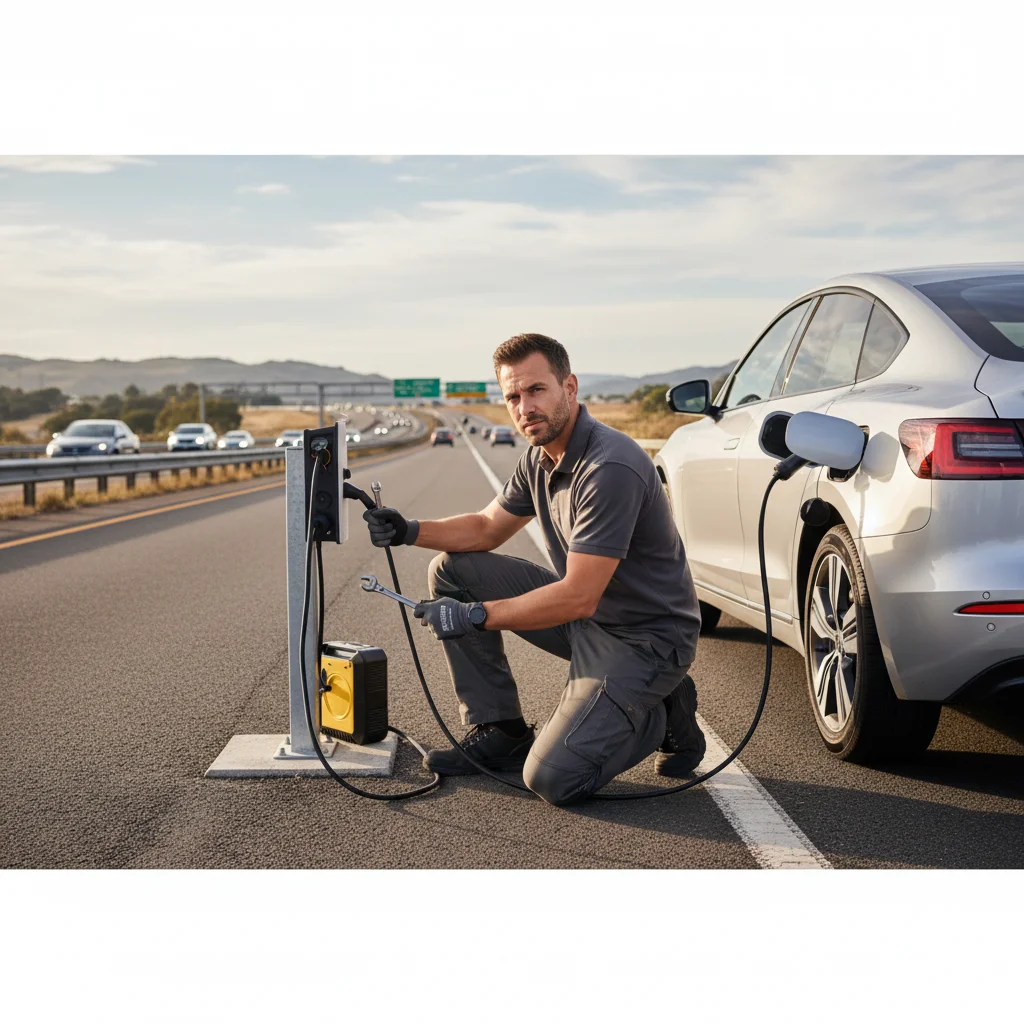
Why the South Bay corridor drains EV range faster than you expect
The I-5 South Bay stretch between downtown and San Ysidro is short on the map and heavy with stop-and-go and border queues. Real-world use is often higher than a highway cruise estimate. This page will not freeze a 17-mile clock, a 40 to 60 percent penalty, a 1 to 3 mile idle burn, or an 85°F AC figure. Check the car’s reading against the actual queue.
The grade changes on this stretch matter too. The I-5 drops and rises through Barrio Logan, National City, and Chula Vista. Those aren’t steep climbs, but they add up on a car already running low.
Charging gaps in National City, Chula Vista, and San Ysidro
Public Level 2 and DC fast charging in the South Bay is thinner than drivers expect, especially if you’re coming from North County or the I-15 corridor where Supercharger coverage is tighter.
| Location | Type | Approximate distance from I-5 shoulder |
|---|---|---|
| Chula Vista Center (H St) | Tesla Supercharger (6 stalls) | ~1.5 miles off I-5 exit 7B |
| Walmart Supercenter, Chula Vista | Level 2 (ChargePoint) | ~2 miles off I-5 |
| National City area | Sparse Level 2 (workplace/retail) | Varies, no dedicated fast charger near freeway |
| San Ysidro (Las Americas) | Level 2 (Blink) | ~0.5 miles from the border crossing |
| Otay Ranch area | Level 2 (multiple retail sites) | ~6 miles east, off SR-125 |
Confirm live, vehicle-compatible stalls. This page will not inventory a Chula Vista Supercharger hop or tell a low-power car to navigate National Blvd or Broadway. If you are already on the shoulder, mobile EV charging is a matching start, not a promised better-than-tow call.
Safe-shoulder protocol on a busy interstate in San Diego
The South Bay section of I-5 sees some of the county’s highest truck and commercial vehicle volume. Northbound freight from the border corridor stacks up through National City. The right shoulder between Chula Vista and National City is often narrow, and in some stretches there’s no shoulder at all through active construction zones.
If your EV is losing power on this stretch, these steps keep you safer:
- Signal right and begin moving toward the shoulder the moment the range drops below 5 miles, not at zero.
- Flip hazards on immediately, even before you’ve committed to pulling over.
- On I-5 between National City and San Ysidro, the right shoulder is your only option. The center divider is concrete barrier with no walkable clearance.
- Once stopped, stay in the car with your seatbelt on. The South Bay section is not a stretch where you want to stand outside on the right.
- If you’ve stopped in a construction zone or where the shoulder has active lane closures, call 911 first. CHP will alert traffic management before you call us.
- Pop your hood or put a visible marker in the rear window. A running vehicle on the shoulder looks like a parked truck to distracted drivers at freeway speed.
Call (858) 400-4465. Direction of travel, nearest exit or mile marker, and make and model help the independent operator.
How mobile rescue works on I-5 South Bay
Charge Pro SD is a referral. Charge Pro owns no Cybertruck fleet and publishes no 240V / 9.6 kW bed outlet, NACS-plus-CCS kit, 50-foot cable, or on-site minute clock as Charge Pro equipment. An independent operator confirms what they bring, whether they can work a South Bay shoulder, price, and timing. You pay them. Shoulder work follows CHP and the operator’s own safety setup, not a Charge Pro cone script.
Charge Pro SD does not publish a 10 to 20 mile result, a 20 to 30 minute on-site clock, or a named Supercharger destination as the outcome of a Charge Pro job. An independent operator confirms whether a charge in place is even possible. Getting to real charging infrastructure is the usual goal when a charge is feasible. That is not a promised mile count.
A dead 12V is different from a depleted traction pack. Both can leave the car immobile. Charge Pro does not diagnose on the phone and does not publish jump gear as Charge Pro equipment. See out-of-charge recovery and emergency EV roadside assistance.
Charge Pro SD can refer an independent operator in listed South Bay cities, including Chula Vista, National City, Otay Ranch, Eastlake, Bonita, and San Ysidro. Charge Pro does not cover them with a Charge Pro crew.
Frequently asked questions
Does Charge Pro SD respond to I-5 South Bay strandings at night?
Yes. Border queues happen day and night. Call (858) 400-4465 for a referral. Charge Pro does not publish a dispatcher ETA.
Can a stranded EV block traffic on I-5 near National City or Chula Vista?
It can if you lose power in an active lane. If you are in a travel lane or another dangerous place, call 911 first. Charge Pro is not traffic control.
Why does waiting at the San Ysidro border drain my EV battery faster?
Climate control at a standstill uses pack energy. This page will not freeze a 90-minute / 3 to 5 mile figure. See running out of charge at the San Ysidro border.
What if the nearest Supercharger isn’t within rolling distance?
Charge Pro SD does not bring energy to the shoulder as a Charge Pro crew and does not require you to be near a charger. An independent operator confirms whether they can work that pin.
Can Charge Pro SD help non-Tesla EVs stranded on I-5 South Bay?
Charge Pro SD can refer an independent operator for a non-Tesla EV on I-5 South Bay. Charge Pro publishes no CCS adapter as Charge Pro equipment. See non-Tesla EV rescue.
How long does a mobile charge take on a South Bay freeway shoulder?
Charge Pro SD does not publish a 20 to 30 minute on-site clock or a 10 to 20 mile Supercharger hop. The operator confirms whether a charge in place is even possible.
If you are stuck on I-5 through National City, Chula Vista, or toward the border, call (858) 400-4465. Charge Pro SD refers. Charge Pro does not confirm it is the right option, publish an ETA, or get a Charge Pro truck moving. The independent operator confirms the job. A tow may be the job. That is their call.
For more on how freeway strandings work across San Diego County, see out of charge on the freeway: what to do and our guide to EV roadside assistance in Chula Vista.