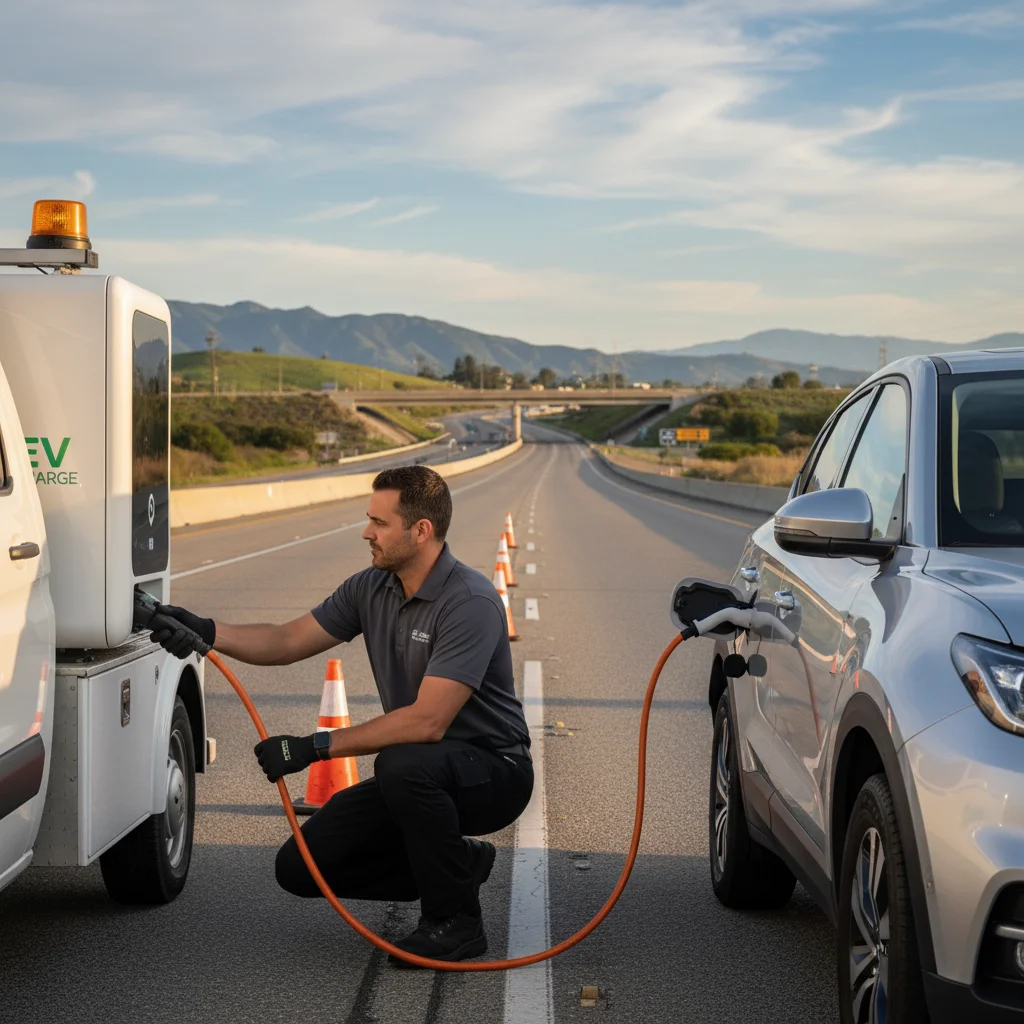
Your battery gauge drops faster than expected on the uphill grade, traffic isn’t stopping, and the nearest public charger is still six miles away. That’s the moment Santee EV drivers call us, not a tow company, not a generic roadside app. Our emergency EV roadside assistance team covers Santee and the surrounding East County routes, and we know exactly where drivers tend to run dry.
Where Santee EV drivers run out of charge
Santee is deceptively hilly. The city sits in a valley, but getting out of it, toward El Cajon, toward Poway, toward Lakeside, means climbing. EV range calculators don’t always account for that. A driver who left home showing 40 miles of range can burn through 15 of them in one sustained climb, especially in summer when the A/C is running.
Public charging inside Santee is limited. There’s a cluster of Level 2 chargers at Santee Town Center near Target and the AMC theater, and a few scattered DC fast chargers along Mission Gorge Road. But if you’re already low and you’re not near those spots, the math stops working in your favor quickly.
We see three recurring breakdown patterns here:
- Drivers coming off SR-52 westbound who underestimated the trip back from Mission Valley
- Shoppers leaving Santee Town Center with less range than they thought they’d need to reach a home charger
- Commuters on Mission Gorge Road who queued in traffic longer than the nav predicted
All three scenarios are recoverable without a tow. That’s the point. A mobile EV charging dispatch gets you enough charge to move yourself to a proper fast charger or make it home, without the extra step of a flatbed and a tow yard.
SR-52 and SR-67 stranded-EV patterns
SR-52 runs east-west along Santee’s southern edge, connecting to I-805 on one end and SR-67 on the other. SR-67 pushes north toward Lakeside and beyond. Both corridors see consistent EV stranding events, and both have limited shoulder space that makes a long wait stressful.
On SR-52, the issue is usually range miscalculation. Drivers heading back from Mission Valley or Kearny Mesa assume they have enough buffer. The grade change between Mission Trails Regional Park and the SR-67 interchange burns more than expected, and suddenly they’re coasting on miles they don’t have.
SR-67 is a different animal. It’s a two-lane highway north of Gillespie Field, and the climbs toward Lakeside are steep and sustained. Drivers who check PlugShare before leaving Santee often discover that chargers along SR-67 are unreliable or fully occupied. When one of those chargers is out of service, the next reasonable option is back in Santee or down in El Cajon, and that return trip may not be feasible on the remaining charge.
We cover both corridors. If you’re on the shoulder of either highway, stay in your car with hazard lights on and call us. We’ll send an operator to you. For drivers who’ve been through a similar situation in the next city over, our EV roadside assistance coverage in El Cajon describes the same approach applied to that stretch of US-8 and SR-67 south.
Town Center, Mission Gorge, and the climb to Lakeside
Surface streets matter as much as freeways in Santee. Mission Gorge Road is the main artery connecting Santee to Mission Valley to the west and Lakeside to the northeast. It’s also a route where drivers get stuck in stop-and-go traffic and arrive at their destination with significantly less range than the nav estimated.
Santee Town Center generates its own breakdown pattern. The chargers there are Level 2, meaning a 30-minute shopping trip adds maybe 10 to 15 miles of range, not enough if you arrived running low. Drivers who planned to “top off while shopping” sometimes leave with less buffer than they expected, especially if the chargers were occupied.
The climb toward Lakeside and Winter Gardens via Mission Gorge Road or SR-67 is where range anxiety becomes range reality. The elevation gain is real, the California Energy Commission notes that steep grades are among the leading factors in real-world EV range deviation from EPA estimates. A Hyundai Ioniq 5 rated at 266 miles might deliver closer to 200 on a summer afternoon running AC through that grade profile.
We’ve also responded to calls near Mission Trails Regional Park, where drivers parked for a hike and returned to a dead 12V battery, not the traction battery, but the auxiliary one that powers the locks and computers. That’s a different rescue than a charge delivery, but it’s one we cover. If your EV is dead and won’t unlock, the operators we send carry jump-start equipment specifically for EV 12V systems.
What the operator brings
The rescue unit dispatched for Santee calls is an operator vehicle-based rig carrying a mobile DC fast charger capable of delivering 20 to 40 miles of range in roughly 20 to 30 minutes, depending on your vehicle’s onboard charging speed. Operators carry CCS, CHAdeMO, and J1772 adapters, covering Tesla (via adapter), Rivian, Ford, Hyundai, Kia, GM, and most other EVs on the road in San Diego County.
Timing in Santee varies by traffic and by which operator is closest when you call, especially along the SR-52 corridor. We’ll give you an honest read on timing on the phone rather than a guess.
Here’s what a typical rescue looks like:
When you call
We confirm your location, vehicle make, and connector type. If you’re on a highway shoulder, we pass your position along to the operator heading your way and note any access constraints.
When the operator arrives
They pull in safely, confirm your state of charge, and connect the mobile charger. While the charge runs, they walk you through next steps, nearest fast charger, whether you’re good to make it home, whether there’s a 12V issue alongside the main pack concern.
When you leave
You drive away. No flatbed, no impound lot, no waiting for a dealer appointment. For context on how this compares to a traditional tow, mobile EV charging vs. tow breaks down the cost and time difference in detail.
Mobile charge vs tow for East County drivers
East County has a geography problem for tow-first rescue. If you strand on SR-67 north of Santee, the nearest EV-capable repair shop that can “just charge you up” isn’t always obvious. Tow companies in the area are experienced with gas vehicles; EV-specific handling, especially for Teslas and Rivians with low-clearance battery packs, requires extra care.
A mobile charge solves the problem without introducing new ones. You’re not dealing with tow fees, storage fees, or the logistics of retrieving your car from a lot. The US Department of Energy’s AFDC tracks mobile charging as an emerging roadside category precisely because it resolves the most common stranding event, running out of charge, without requiring vehicle transport.
For Tesla drivers specifically, the calculation is sharper. Tesla’s own roadside program can dispatch a charge van, but wait times in East County are inconsistently long. Our Tesla rescue coverage in Santee operates independently of Tesla’s own network and gives you another option in this geography.
Non-Tesla drivers are covered just as fully. Operators bring the right connector for your car. If you’re curious about what the operator vehicle carries in detail, a look inside a mobile EV charger truck explains the full equipment setup.
One thing we don’t do: we’re not a charging installation company. If you searched for home EV charger installation in Santee, that’s a different service we can’t help with. What we do is rescue, when you’re stranded, when the charge ran out, when the 12V died in a parking lot and you can’t get in your car.
When to call Charge Pro
Call us when you’re stranded on SR-52, SR-67, Mission Gorge Road, or anywhere else in Santee with a depleted battery, a dead 12V, or a range emergency that a public charger can’t solve. We send operators to you, highways, parking lots, residential streets, trailheads. Call us at (858) 400-4465 and we’ll connect you with a local operator.