The range hits zero on SR-52 and the car starts to coast. You are on the east-west freeway that ties La Jolla and University City to Kearny Mesa, Tierrasanta, Mission Trails, and Santee. Get out of the travel lanes first, then give a local operator a pin they can actually find.
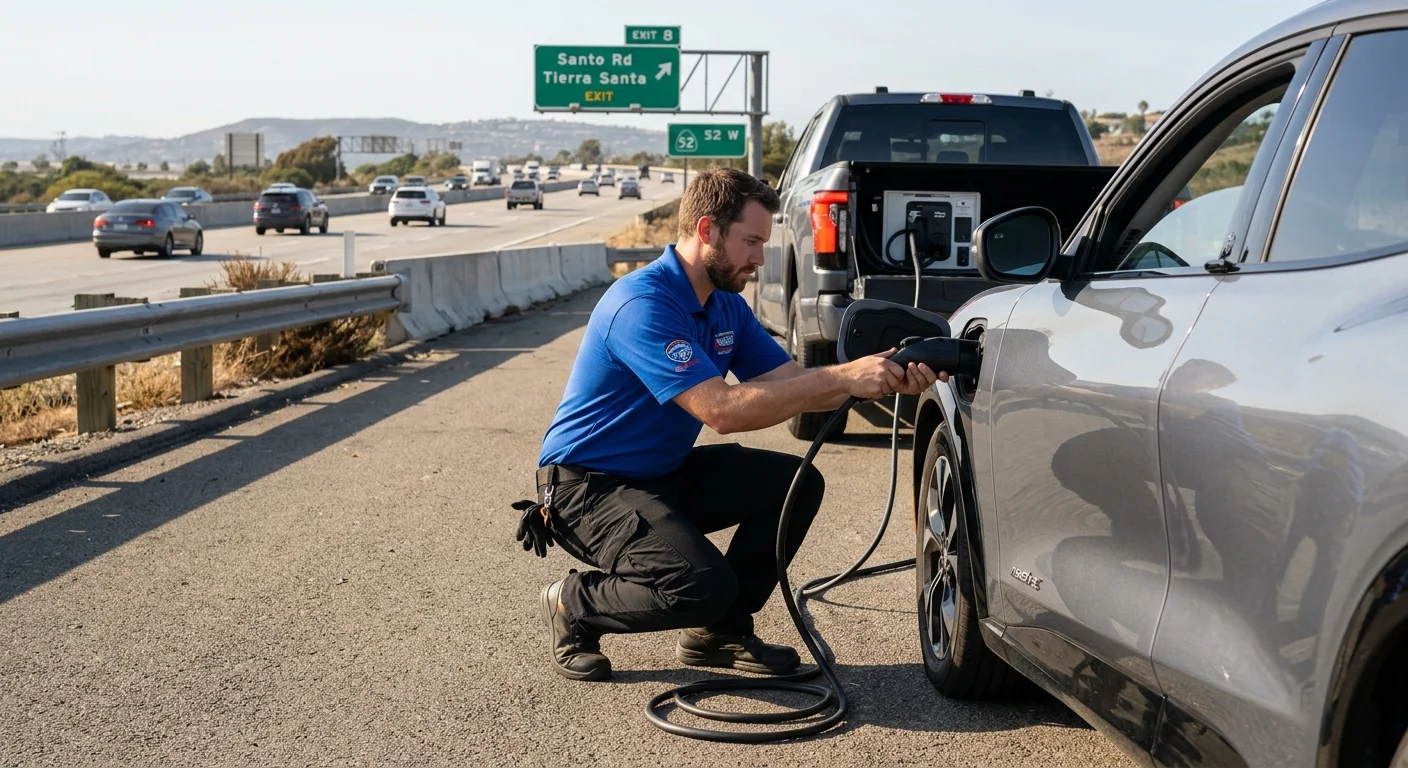
Identify your direction and nearest exit
SR-52 runs east-west. Westbound heads toward I-5 and the coast. Eastbound heads toward Santee, SR-125, and SR-67. Say which way you were driving before you say anything else.
Then name the last exit you passed and the next sign you can read. West of I-15 that may be Genesee Avenue, Regents Road, or Convoy Street in Kearny Mesa. Santo Road is the Tierrasanta marker. East of I-15 you are in Mission Trails country, then Mast Boulevard into Santee. If you can see the SR-125 connectors, say so. If you just came off I-805, say that too.
Mile markers help when ramps are far apart. Overpass names help when the next exit is still out of sight. “Eastbound SR-52, past Santo, before Mast, right shoulder” is a location. “Somewhere on 52” is not.
If the car can still roll, an exit is usually safer than a live lane. Clairemont, Kearny Mesa, and Santee have surface streets where an operator can stand next to the car. The canyon cut through Mission Trails and San Clemente Canyon has fewer places to pull fully out of traffic. Do not assume a wide shoulder just because you are on a freeway.
If you are already stopped, stay with the facts you have. Direction. Last exit. Next landmark. Left or right shoulder. That is the map an independent operator uses to decide whether they can reach you.
If you were aiming for a charger in Santee, or back toward I-5, and never made it, say the destination you missed. A city name alone is not enough on this corridor. Out-of-charge EV recovery starts with the route, the heading, and the last ramp, not a neighborhood nickname.
Write those five items in a notes app before the next call drops: direction, last exit, next exit, shoulder side, and whether you are still in a lane. Read them back the same way every time you talk to 911, 511, a manufacturer app, or a referral line.
Follow current roadside safety guidance
California Highway Patrol says to call 911 when a disabled vehicle is in a dangerous location or a traffic lane. That includes a dead EV sitting in a through lane on SR-52, a car stopped in a gore point, or a vehicle on a curve traffic cannot see. Put the hazards on if they still work. Get occupants out of the travel lane only if it is safe to exit.
If you are already fully on the shoulder and out of the live lanes, CHP says metropolitan callers can use 511 and say “Roadside Assistance.” That is a request line. It is not a promise that a particular truck is assigned to your mile.
CHP’s Freeway Service Patrol runs on designated routes during published operating periods. Charge Pro SD could not confirm from public CHP materials whether your exact SR-52 stretch is on a live beat at this hour. If a patrol does stop, and the car cannot restart, CHP says they may take you to an approved drop location. That is not a shop or a home you choose.
Do not walk the canyon. Mission Trails grades and San Clemente Canyon leave little room beside the concrete. Stay with the vehicle unless staying puts you in traffic.
Call your manufacturer channel if you have one. Tesla directs owners to request roadside through the Tesla app, and says out-of-range help may be available but is not financially covered. Other brands run their own programs. None of that replaces 911 when you are in a lane.
The same order holds on every San Diego freeway: make the scene safe, then describe it. Our freeway out-of-charge steps follow that sequence for I-5, I-15, and the rest of the county. SR-52 just needs the heading and the last exit named with more care, because the ramps jump from city grid to parkland in a few miles.
Tell empty charge from lost low-voltage power
An empty traction battery and a dead 12-volt (or other low-voltage) battery can feel the same from the driver’s seat. They are not the same job, and the operator needs to hear the difference.
Empty pack: the car was moving, the range counted down, and it stopped. Screens may still work. Locks and windows may still work. Hazard lights may still flash. The high-voltage system has nothing left to send to the motors. That is a charge or transport problem.
Lost low-voltage power: the car may still show miles, or it may have been parked. Screens go dark. The car will not wake. Doors and the charge port may not act normal. You are not “out of charge” in the highway sense. You have a low-voltage problem. Jumping that system is model-specific. Do not improvise cables on an SR-52 shoulder. Tell the operator the make, model, year, and what still works.
If you are not sure, describe symptoms, not a diagnosis. “Range hit zero eastbound at Mast” is useful. “I think it’s the 12-volt” is a guess unless the dash already said so.
Say whether the car is a battery-electric or a plug-in hybrid. A PHEV that can still start the engine may not need a pack charge on the shoulder. A BEV with a true empty pack will.
The U.S. Department of Energy notes that charging time depends on state of charge, battery capacity and type, the vehicle’s onboard charging capacity, equipment output, and electrical service. A mobile operator has to match the connector and the kind of current they carry. J1772, NACS (J3400), and CCS are not interchangeable just because a plug looks close. Ask the operator to confirm your port and any approved adapter before they accept the job.
Do not copy a jump map from a forum while you sit in the canyon. Independent operators decide whether a low-voltage assist is even possible at your pin. Your job is the symptom list, the model year, and the shoulder.
Share shoulder and access details
SR-52 is not one kind of road. The west end near I-5 sits in University City and Clairemont, with frequent ramps. Kearny Mesa is industrial and relatively open. Tierrasanta sits above the freeway with only a handful of ways down. East of I-15 the road cuts through Mission Trails, then drops into Santee toward SR-125 and SR-67.
Tell the operator all of this:
- Eastbound or westbound
- Left shoulder, right shoulder, or still in a lane (and that you already called 911 if you are)
- Last exit and next exit
- Whether you can see an overpass, a trailhead lot, or the SR-125 connectors
- Whether the car is against a concrete barrier
- Whether a gate, gore, or steep drop would block a truck from pulling in behind you
If you made it onto Mast Boulevard, Cuyamaca Street, or Mission Gorge, say you are off the freeway. Surface streets in Santee are a different access problem than a canyon shoulder. For that east-end neighborhood pattern, see EV roadside assistance in Santee. This page stays on the corridor.
Photos help when you have signal. One shot of the next sign. One shot of how much dirt, wall, or guardrail sits beside the car. Do not step into a lane to take them.
Do not assume cell coverage is solid through the park. If the call drops, send a text with the same facts: direction, last exit, shoulder side, make and model, empty pack or dark low-voltage system.
Charge Pro SD is a referral line. It matches you with licensed, independent local operators. It owns no trucks, sets no prices, and does not perform the work. The operator who accepts the job decides whether they can reach that pin. They quote their own price and timing. Ask for both before you agree.
Choose mobile charging or transport
Once you are safe, the fork is simple. Can the car take a charge on that shoulder, or does it need to leave the freeway.
Mobile EV charging is on-site energy from an independent operator’s equipment. It is not a public DC fast charger, and it is not a guaranteed percentage. The U.S. Department of Energy describes AC Level 2 as 240 V in typical homes or 208 V in typical commercial settings, with equipment from about 2.9 to 19.2 kW. DC fast charging is a different class. Connector type alone does not prove a unit matches the voltage and power your car can take. The operator has to confirm the vehicle, the port, any approved adapter, and whether they can work at your exact pin.
A short charge may get you to a public station off Mast, in Kearny Mesa, or back toward I-5. It may not. Nobody on this page can promise delivered energy, a drive time, or an open stall when you arrive. Confirm live station status in your charging app after the car can move.
Transport is the other path. If the shoulder is too tight, if low-voltage power is gone and the car will not go into the mode your manual requires for a tow, or if the operator cannot charge there, a flatbed is often the honest answer. Follow the owner’s manual for how that model must be hauled. The operator who would move you sets the method and the destination they will accept.
Manufacturer roadside, an auto-club dispatch, and emergency EV roadside assistance can all be in the mix. Membership plans often list jumps, lockouts, and tows. They do not always include packing energy into an empty EV. GEICO’s published emergency roadside list, for example, covers towing, jumps, tires, lockouts, winching, and fuel delivery, and does not list on-site EV pack charging. Ask each program what they will actually send to this stretch of SR-52.
Charge Pro SD does not own a fleet and does not set prices. We match you with a licensed, independent local operator. You contract with them directly. Confirm make, model, year, port, symptoms, and the shoulder details above before anyone starts driving.
When to call us
Call when the car is already stopped on SR-52, or you are coasting toward an exit and will not make a charger. Call when you need a local operator to attempt a charge or a tow from that pin. Call us at (858) 400-4465 and we’ll connect you with a local EV rescue operator.