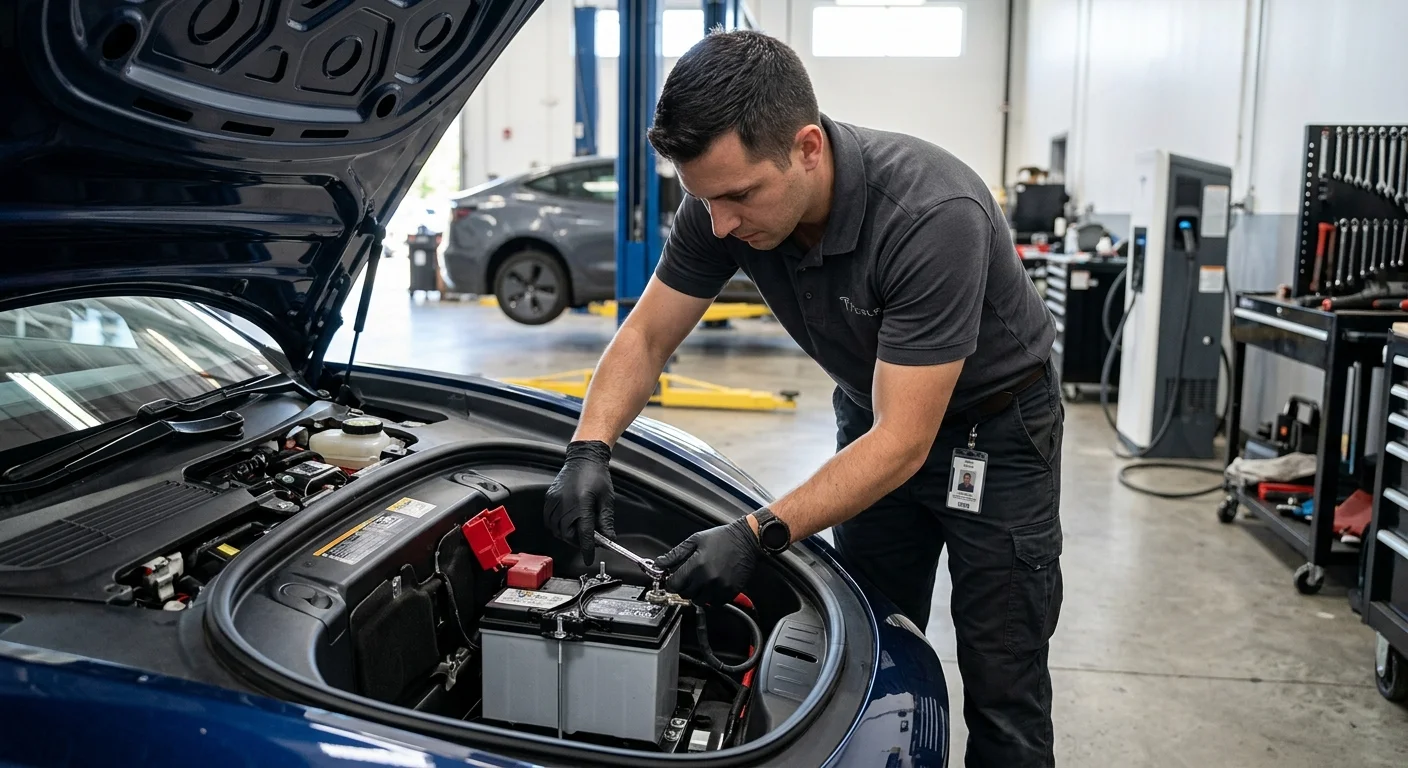
When a Hyundai Ioniq 6 won’t start, a dead 12V auxiliary battery is the most likely cause, not an empty traction pack. The Ioniq 6 shares its E-GMP platform with the Ioniq 5, and both models carry the same 12V vulnerability: if that small battery drains, the car goes completely dark and won’t respond to the start button, key fob, or door handles. Traction battery charge level doesn’t matter.

EV 12V auxiliary battery being accessed for roadside rescue in San Diego

The sedan body and the E-GMP chassis share a lot, but the Ioniq 6 has a few specifics worth knowing before you start troubleshooting. This guide covers where the 12V battery lives, how the auxiliary battery save button works, where the jump points are, and what to do if you’re stuck somewhere in San Diego County.

Why the Ioniq 6 goes completely dark

Every EV on the E-GMP platform runs two batteries in parallel. The large traction pack (77.4 kWh on the standard Ioniq 6 AWD) moves the car. The 12V auxiliary battery runs everything else: the computer that initializes the traction system, door locks, windows, infotainment, headlights, and the CAN bus that lets all those modules talk to each other. If the 12V dies, the traction pack is effectively locked out. The car can’t boot.

The Ioniq 6 has a known E-GMP behavior that catches owners off guard. When the traction battery drops to a critically low state of charge, the BMS (battery management system) can stop topping off the 12V battery. If the car then sits for several days without charging, the 12V can drain completely. This means a Ioniq 6 with a partially charged traction pack can still go dark if it’s been sitting with a marginal 12V battery.

Hot San Diego weather accelerates this. The coastal marine layer doesn’t protect the 12V from heat cycles the way you might expect. Parking in direct sun in Chula Vista, El Cajon, or Santee during summer stresses auxiliary batteries faster than overnight lows ever recover them. A two- or three-year-old Ioniq 6 12V battery in San Diego is worth watching.

What happens when an EV 12V battery dies covers the full cascade in more detail if you want to understand the system before you troubleshoot.

Where the 12V battery is on an Ioniq 6

This is the detail that trips people up. On the Ioniq 5 crossover, the 12V battery is tucked under the front hood frunk area. On the Ioniq 6 sedan, the 12V battery is located in the trunk, on the driver’s side under a trim panel. You access it by opening the trunk and pulling back the cargo floor liner on the left side.

The battery itself is a standard AGM unit (absorbed glass mat, not lead-acid flooded). You do not jump-start it from the trunk terminals. The correct jump points are under the hood.

Here’s what the setup looks like:

LocationWhat’s there
Trunk, driver’s sideActual 12V battery (AGM)
Under hood, driver’s side fuse boxPositive (+) jump terminal (red cap)
Under hood, engine bayUnpainted chassis bolt for negative (ground)
Instrument cluster (when active)Auxiliary battery save button

The hood does open on the Ioniq 6 even though there’s no frunk storage. Pop it using the interior hood release and look for the black fuse box cover on the driver’s side. Lift the red cap to expose the positive terminal. Find a bare metal chassis bolt for your ground connection. Do not connect the negative clamp to the 12V battery’s negative terminal in the trunk.

The auxiliary battery save button

The Ioniq 6 has an auxiliary battery save mode that the Ioniq 5 doesn’t have in the same form. When you’re running accessories (parked with the infotainment on, charging a phone, or sitting in the car for an extended time without the drivetrain active), you can activate this mode through the instrument cluster settings. It limits the draw on the 12V battery to prevent it from draining below a recovery threshold.

It’s not a fix for a battery that’s already dead. But if you’re parked at a trailhead in Mission Trails or waiting for someone at the airport, activating it before you sit for an hour or more is cheap insurance. The menu path varies slightly by trim level and firmware version, but it’s typically found under Settings > Vehicle > Auxiliary Battery.

How to jump-start a Hyundai Ioniq 6

You’ll need a portable jump pack or a second vehicle with working jumper cables. The process is safe and straightforward as long as you use the correct terminals.

  1. Open the hood using the interior release.
  2. Locate the black fuse box cover on the driver’s side of the engine bay.
  3. Lift the red plastic cap to expose the positive (+) terminal.
  4. Connect the red (positive) clamp to that terminal.
  5. Find a bare, unpainted metal bolt on the chassis for the negative (ground). A good spot is a sturdy bolt on the firewall or a strut tower.
  6. Connect the black (negative) clamp to that bolt.
  7. If using a donor car, connect the other ends to the donor’s battery terminals (positive to positive, negative to negative), then start the donor.
  8. Wait two to three minutes for the Ioniq 6’s 12V to accept some charge.
  9. Attempt to start the Ioniq 6. The startup sequence takes a few seconds longer than normal after a dead 12V restart.

If the car starts, drive it to a charger immediately. A dead or depleted 12V battery won’t recover reliably from a single jump without time on a charger. If it dies again within an hour, the 12V battery needs replacement, not another jump.

For the full safe jump procedure on any EV, see how to jump start an EV safely.

San Diego scenarios where this happens

Dead 12V situations follow a pattern in San Diego County. Here are the most common ones we see:

Long-term parking near the airport or cruise terminal. Drivers leave the Ioniq 6 at a surface lot in National City or the park-and-ride near Old Town for 10 to 14 days. If the traction pack was below 50% at departure, the 12V may not have enough to restart on return.

Beach parking in Pacific Beach or Ocean Beach. Marine-layer humidity combined with heat cycling when the sun burns off accelerates 12V sulfation. A car that sat fine on a Tuesday can be dead by Saturday after a hot week.

I-15 corridor commuters. High weekly mileage depletes the traction pack faster than most drivers realize. If the car parks overnight at less than 15% traction charge and the 12V was already marginal, morning startup failures are more common than the owner’s manual suggests.

East County summer heat. El Cajon and Santee regularly hit 100°F+ in July and August. Extreme heat is the single fastest way to age a 12V AGM battery. If your Ioniq 6 is two years old and you park outdoors in East County, get the 12V tested at your next service appointment.

Charge Pro SD covers all of these areas. We can reach most San Diego County locations in 25 to 60 minutes. Our rescue vehicle is a Tesla Cybertruck with a 240V / 9.6 kW bed outlet and both NACS and CCS connectors. We bring charge to you, which solves a low-traction-pack situation, but for a dead 12V we also carry the equipment to get your system back online.

If you’re in Chula Vista or anywhere south, see our Chula Vista EV roadside page for local dispatch details.

For any non-Tesla EV stranded in San Diego, our non-Tesla EV rescue service is the right call.

Frequently asked questions

How do you jump-start a Hyundai Ioniq 6?

Use the positive terminal under the hood in the driver’s side fuse box, not the actual 12V battery in the trunk. Connect the positive clamp to the red-capped terminal in the engine bay, and the negative clamp to a bare metal bolt on the chassis. Wait two to three minutes, then attempt to start the car. The trunk-mounted battery is real but the jump points are under the hood.

Where is the 12V battery in a Hyundai Ioniq 6?

The Ioniq 6’s 12V auxiliary battery is in the trunk on the driver’s side, under the cargo floor trim panel. This differs from the Ioniq 5, where it’s located up front. The actual jump terminals, however, are under the hood in the engine bay.

Can a Hyundai Ioniq 6 die if the traction battery has charge?

Yes. If the 12V auxiliary battery dies, the car loses all electrical power regardless of how much charge is in the traction pack. The 12V battery powers the computer that wakes up the high-voltage system. No 12V power means the car can’t boot, even with a full main battery.

Does Charge Pro SD come to Hyundai Ioniq 6 owners in San Diego?

Yes. Charge Pro SD serves all 67 cities in San Diego County and responds to Hyundai, Kia, and all other non-Tesla EV models. Typical dispatch is 25 to 60 minutes. Call (858) 400-4465.

What’s the auxiliary battery save button on the Ioniq 6?

It’s a mode you activate through the instrument cluster settings that limits power draw from the 12V battery when you’re parked with accessories running. It won’t revive a battery that’s already dead, but it’s useful for preventing drain during extended parked sessions at the beach, airport, or anywhere you’re sitting without the drivetrain active.

How long does an Ioniq 6 12V battery last in San Diego?

Most EV 12V batteries last three to five years under normal conditions. San Diego’s summer heat, especially in East County, shortens that window. If your Ioniq 6 is approaching three years old and you park outdoors, have the 12V tested. A weak battery that jumps once will often fail again within a few weeks.


If your Ioniq 6 is dark and unresponsive somewhere in San Diego County, Charge Pro SD can help. We carry jump equipment and mobile EV charging on every dispatch. Call us at (858) 400-4465 and we’ll have someone headed your way.

Our sister post covers the Ioniq 5 crossover in detail: Hyundai Ioniq 5 won’t start guide. For a deeper look at 12V battery failure across all EV brands, see EV 12V battery replacement guide.