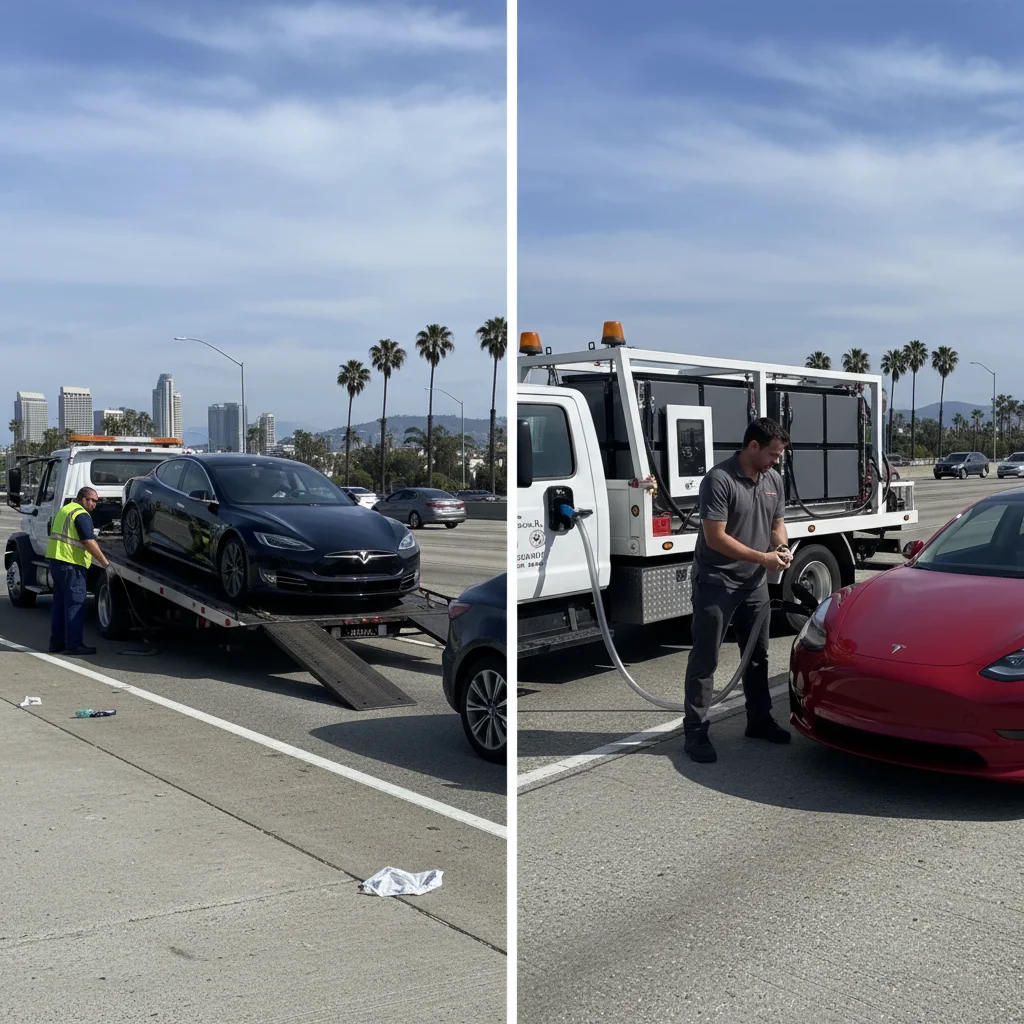
The dreaded “low battery” warning has turned into a “pull over now” reality. You’re on the shoulder of the I-15 or stuck in a parking garage in La Jolla with zero percent battery. Now you face a critical decision: do you call for a mobile charge to get you moving again, or do you call for a tow truck? The answer often comes down to simple math.
What a mobile EV charge actually costs in San Diego
When your electric vehicle runs out of power, a mobile EV charging service is like a gas can for the electric age. A specialized truck comes to you and provides enough of a charge to get you to the nearest public station or safely back home. It’s the most direct solution to an empty battery.
In San Diego County, the cost for a mobile charging service in 2026 typically depends on the work needed and your location.
The price usually covers a few key components:
- Dispatch: Getting a trained operator and a specialized charging truck to your location. This covers fuel, vehicle wear, and the operator’s time.
- Service Call: The labor for setting up the charger, ensuring a safe connection, and delivering the power.
- Energy Delivered: Operators typically deliver a set amount of range, usually 20-30 miles worth of charge. This is more than enough to get you out of a bind and to a DC fast charger without causing range anxiety.
The advantage here is that the operator quotes you before starting, so you know what you’re paying to solve your immediate problem before any work begins, which is a service we specialize in called out-of-charge recovery. For a more detailed breakdown, you can read our guide on how much mobile EV charging costs.
What a flatbed tow costs for an EV in 2026
Towing an electric vehicle isn’t like towing a 20-year-old Honda Civic. Because of their complex drivetrains and the risk of damaging the electric motors, nearly all EV manufacturers, including Tesla, Rivian, and Ford, mandate the use of a flatbed tow truck. You can’t use a traditional hook-and-chain or dolly tow.
This requirement makes the tow more expensive. In the San Diego area, a flatbed tow for an EV in 2026 can easily cost between $250 and $500+, and often more.
The invoice for an EV tow typically includes several line items:
- Hook-up Fee: This is the base charge for the tow truck arriving and securing your vehicle to the flatbed. This fee alone often starts at $100-$175.
- Per-Mile Charge: This is where the cost really climbs. Towing companies typically charge between $5 and $8 per mile. A 20-mile tow to the nearest compatible charger can add another $100-$160 to your bill.
- Special Equipment/Labor: If your EV is in a tight spot, like an underground parking garage or on a steep hill, extra fees for winching or special maneuvering can apply.
- After-Hours Surcharge: If you’re stranded late at night, on a weekend, or on a holiday, expect to pay a premium.
Tow operators provide a necessary service, and their pricing reflects the expensive equipment and specialized training required for safely transporting heavy, high-tech vehicles. The problem isn’t the service itself, but that it’s often not the right tool for a simple out-of-charge situation.
Distance, time of day, and surge pricing for both
The final bill for roadside assistance is rarely a single, flat number. A few key variables can dramatically change what you pay for either a mobile charge or a tow, and understanding them helps clarify the mobile ev charging cost vs tow comparison.
Distance is the biggest factor
For a tow, distance is the enemy of your wallet. That per-mile fee means the cost isn’t fixed until your car is dropped off. A tow from Carlsbad to a dealership in Kearny Mesa could be a 30-mile trip, potentially adding $150-$240 in mileage fees alone on top of the base hook-up cost. A mobile charge, by contrast, is priced based on the work your situation needs rather than pure mileage. The operator quotes you before starting, so you know what to expect regardless of where in San Diego County you are. You’re paying for the solution, not the travel time.
Time of day and weekends
Both towing companies and mobile charging services may have surcharges for service outside of standard business hours. Late nights, weekends, and holidays are peak times for roadside incidents. However, these fees are often more pronounced in the towing industry. A late-night flatbed call can sometimes be double the daytime rate. After-hours calls can affect pricing for any service, but the operator quotes you before starting so there’s no surprise once the work is done.
Surge pricing and high demand
During major traffic events, storms, or holidays, demand for all roadside services spikes. This can lead to longer wait times and higher prices across the board. Towing dispatch networks often use dynamic pricing, similar to ride-sharing apps, where rates increase with demand. This can turn a $300 tow into a $500+ ordeal. While availability can be a challenge for any service in these situations, an operator quoting you before starting provides a crucial buffer against unpredictable price surges.
Insurance and roadside-club coverage notes
Many drivers assume their insurance or a club like AAA will cover them completely. The reality is more complicated, and the fine print matters, especially with EVs.
AAA coverage
AAA is a staple for many drivers, and their Premier plan offers generous towing benefits, including one tow up to 200 miles and several others up to 100 miles. However, using one of these valuable long-distance tows for a simple 15-mile trip to a charging station is a waste. You’re burning a benefit that could save you thousands on a mechanical breakdown far from home. Furthermore, while AAA is beginning to deploy its own mobile EV charging trucks, their availability in San Diego is still very limited. You’re more likely to get a long wait followed by a tow truck.
Tesla roadside assistance
Tesla provides roadside assistance for its vehicles under warranty. For an out-of-charge event, they will typically cover a tow for up to 50 miles, but only to the nearest public charging station or a Tesla Supercharger. If you want to be towed home or to a different location, you’ll pay the difference. According to Tesla’s support page, they consider this a driver’s responsibility, and repeat incidents may not be covered for free. They may dispatch a third-party mobile charging provider, but this isn’t guaranteed and depends on local partnerships.
Standard auto insurance
Most basic roadside assistance add-ons from carriers like Geico or Progressive have very low coverage limits, often just $75 or $100 per incident. This might cover the hook-up fee for a flatbed, but you’ll be paying the entire per-mile cost and any other surcharges out of pocket. It will almost never cover the full ev tow cost in San Diego.
When the cheaper option isn’t the smarter option
In most cases, a mobile charge is both cheaper and more efficient than a tow. However, there is one critical scenario where a tow is the right, and only, choice.
If your EV’s screen is flashing red warnings about “Powertrain Failure,” “High Voltage Battery Error,” or a “12V Battery System Fault,” your problem isn’t just an empty “tank.” These messages indicate a serious mechanical or electrical issue that a mobile charge cannot fix. In this situation, adding more energy to the system won’t help and could be unsafe. The only correct course of action is to get the vehicle towed directly to a qualified service center.
But for the 99% of cases where the car is perfectly healthy and simply ran out of range, mobile charging is the superior option. Think about the total time and hassle. A tow involves waiting for the truck, the slow process of loading and securing the vehicle, the drive to the destination, and then unloading. This can easily take 2-3 hours out of your day, and at the end of it, you still have to charge your car.
A mobile charge versus a tow isn’t just a cost comparison; it’s a time comparison. Once an operator arrives, you’re typically back on the road under your own power in far less time than the multi-step tow process takes. We solve the problem on the spot instead of just moving it to a different location.
When to call Charge Pro
If your EV is out of battery, showing no critical system warnings, and you’re stranded anywhere in San Diego County, mobile charging is often the more practical and cost-effective solution. Whether it’s an empty high-voltage battery or a dead 12V system that’s left you locked out, we connect you with an operator who has the equipment and expertise to get you moving again.
Call us at (858) 400-4465. We’ll connect you with an operator who brings an operator rig to you.